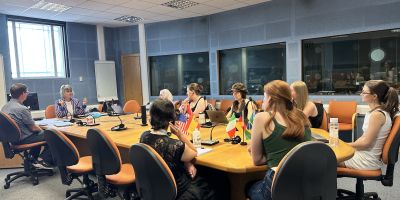
Leeds MA Conference Interpreting Cohort Visits UNESCO Headquarters for Dummy Booth Interpreting Experience

Leeds MA interpreting students visited UNESCO in Paris, gaining hands-on dummy booth interpreting experience, meeting professionals, and exploring multilingual communication in practice.
Leeds MA Conference Interpreting Cohort Visits UNESCO Headquarters for Dummy Booth Interpreting Experience
In June 2026, students from the 2025-2026 cohort of the MA Conference Interpreting and Translation Studies (MACITS) programme at the University of Leeds visited the Headquarters of the United Nations Educational, Scientific and Cultural Organization (UNESCO) in Paris for an immersive professional learning experience.
The visit was organised under the Memorandum of Understanding (MoU) between UNESCO and the University of Leeds, and was led by Ms Grace Lihong Pan, Lecturer in Chinese Interpreting and Business Interpreting, who coordinated with UNESCO language professionals to organise a programme that offered students unique insights into multilingual communication within an international organisation. Combining professional talks, exchanges with experienced interpreters and translators, and dummy booth interpreting practice on the eleventh session of the General Assembly of the States Parties to the Convention for the Safeguarding of the Intangible Cultural Heritage, the visit enabled students to connect their classroom learning with real-world institutional practice.
Throughout the visit, students explored UNESCO's multilingual working environment and gained first-hand understanding of how interpreting and translation support international cooperation in the fields of education, science, culture, and communication. They observed the operation of conference facilities and learned about the preparation, teamwork, and decision-making required to deliver high-quality language services in multilingual conferences.
A particular highlight of the programme was the opportunity to meet with senior conference interpreters and translators from UNESCO's language services. During interactive discussions, students gained valuable insights into the competencies required of institutional interpreters, including advanced listening and analytical skills, subject preparation, terminology management, teamwork, and the ability to perform under pressure.
Students also learned about the evolving role of artificial intelligence and language technologies in professional translation and interpreting.
The visit also provided students with an opportunity to engage directly with experienced professionals, ask questions about the realities of working in international organisations, and gain a deeper appreciation of the role language professionals play in promoting dialogue and mutual understanding across cultures.
The impact of the visit is perhaps best reflected in the students' own words. Their reflections illustrate how the experience enhanced their understanding of professional interpreting and translation, broadened their perspectives on multilingual communication, and strengthened their aspirations to pursue careers in international organisations.
Visiting UNESCO was a profound privilege that allowed me to observe interpreters facilitating global dialogue across cultures and nations. It was an invaluable experience that provided a concrete professional standard to strive for. I was truly amazed by the interpreters in action, and I deeply appreciated both the opportunity and the guidance provided by the UNESCO staff. - Jerry
It is a great honour to have the opportunity to visit UNESCO. Taking part in this international conference and interpreting from a dummy booth has been an invaluable and enlightening experience. Listening to the full conference live helped me pick up plenty of professional interpreting techniques. Meanwhile, witnessing real international debates has widened my international perspective significantly. I would like to express my sincere gratitude to the UNESCO staff and the University of Leeds for offering me this remarkable opportunity. -Shayne
The dummy booth session at UNESCO was a valuable learning opportunity. Listening to live conference proceedings, I experienced the real pressure of pace and unpredictability, which classroom practice cannot fully replicate. The key lesson was in "active listening" - anticipating speech while managing output. I also gained a clearer sense of the interpreter's role in facilitating communication across languages. This experience gave me a concrete professional standard to aim for. I am really grateful to UNESCO and the Centre for Translation, Interpreting and Localisation Studies (CTILS) at the University of Leeds for this opportunity. - Phoebe
On behalf of all our students and staff members, we would like to thank UNESCO again for their generous support and guidance throughout the process, and our special gratitude goes to: Ms Lara Rivard, Interpreter and then Team Leader of the Interpretation Unit; Ms Natalie Lowe, Senior Reviser in the English Translation Unit; Mr Aissam Benchaira, Interpreter and the current Team Leader of the Interpretation Unit; Mr Dezheng Liu, Chief of the Chinese Translation Unit; Ms Yajing He, Translator in the Chinese Translation Unit, and many staff members behind the scenes.
This dummy booth study visit reflects the shared commitment of the University of Leeds and UNESCO to fostering excellence in multilingual communication and interpreter education. By connecting academic study with authentic professional practice, this collaboration inspires the next generation of language professionals to contribute confidently to international dialogue, cooperation, and mutual understanding across cultures.