

Research Seminar: Auralisms: The Relativity of Acoustic Presence
- Date: Monday 5 October 2026, 16:00 – 17:00
- Location: Music
- Cost: Free
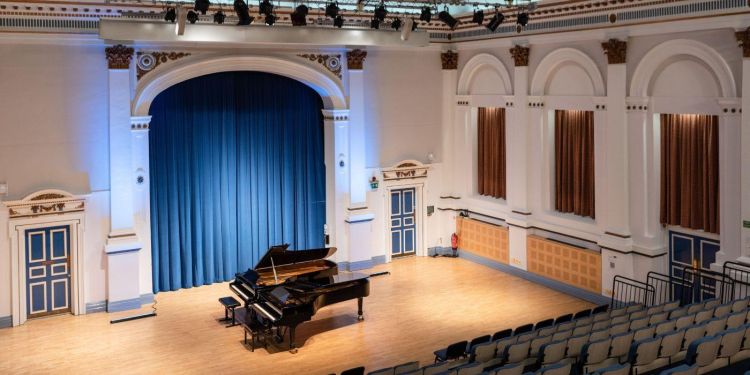
Location: Lecture Theatre 2, School of Music
Constanza Bizraelli
The talk will explore the conceptual approach behind the creation of the algorithm for Auralisms. It will also discuss the philosophical aspects that inform the parts that structure the model and will introduce the speculations behind the thought experiment: “what would it mean to convert spacetime into sound?”
As mentioned, the creation and development of a speculative model of spacetime-to-sound conversion is one of the main aspects of the research, that facilitates conceptual and experiential approaches to the phenomenon of presence. This model was sketched through an algorithm and lately developed into custom Max-for-live devices that modulated the spatial sound in real time. Within the installation, participants become active centres of acoustic transformation. As they enter and move through the space, their presence generates what I described as aural concavities: localized distortions in the spatial and temporal organisation of sound. The sonic environment is therefore not fixed. It continuously changes in relation to the bodies inhabiting it. Through listening, participants encounter the effects of their own presence as transformations within the medium that surrounds them. This produces a particular inversion of the conventional relationship between listener and sound. Rather than simply listening to an external sonic object, the listener becomes aware of themselves through the changes they introduce into the sonic field. Presence becomes relational and spatially fluid: something that is not simply possessed by an individual, but emerges through an interaction between body, space, perception and medium. The talk will also consider the project's engagement with ideas derived from Eastern philosophical traditions, particularly concepts concerning subtle or multiple forms of embodiment. These ideas led to the development of the notion of “multiple-bodied” presence: the possibility that presence may operate across different experiential, spatial and temporal registers rather than being reducible to a single physical body or location. Finally, the talk will include documentation and examples from the development of the interactive spatial sound composition and algorithmic model.
Constanza Bizraelli is a Peruvian composer, songwriter, producer, sound artist and philosopher. She has released music under the alias CAO, on several labels such as Opal Tapes, Club Chai, Seagrave among others.
This will be a hybrid event. The guest speaker will be present with us in the School of Music, and colleagues and other guests are encouraged to join us there. But if you are unable to do so then please consider joining us via Teams.
No booking is required. Those wishing to attend online should contact series convenor Dr Mic Spencer (m.spencer@leeds.ac.uk).