

Research project
Men, Women and Care: The gendering of formal and informal care-giving in interwar Britain
- Start date: 1 September 2015
- End date: 31 August 2020
- Funder: European Research Council
- Primary investigator: Professor Jessica Meyer
- Postgraduate students: Eilis Boyle; Bethany Rowley
- Postdoctoral researcher: Dr Alexia Moncrieff
- Postgraduate researchers: Charlotte Tomlinson; Sian Hibbert
Description
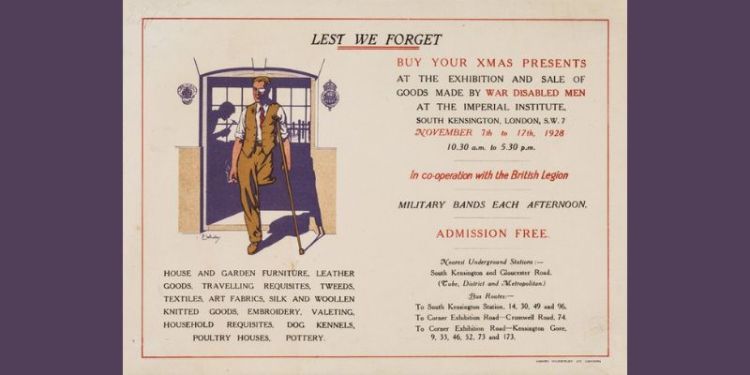
Lest we forget: Buy your Xmas presents at the exhibition and sale of goods made by war disabled men at the Imperial Institute, South Kensington, London, S.W.7 November 7th to 17th, 1928 ... : in co-operation with the British Legion : admission free / Imperial Institute ; [illustrated by] E. Whatley. Source: Wellcome Collection. Public domain mark.
One of the most profound effects of the war efforts of combatant nations during the First World War was the high number of casualties caused by industrial warfare. The Men, Women and Care project investigated the state and domestic structures which developed in Britain in the interwar years to provide medical and social care to the unprecedented number of war disabled. In particular it explored how different spheres of care were shaped by gendered understandings of care-giving and how gender was used to mobilize support for disabled ex-servicemen.
At the centre of the project was the development of a database of material relating to the care of British disabled ex-servicemen, drawing on the 22,756 files held in the PIN 26 section of The National Archives, Ministry of Pensions and Successors: Selected First World War Pensions Award Files. The creation of a proof-of-concept database enabled team members to carry out quantitative analysis of data recorded identify relevant files for closer qualitative analysis of the documents they contain. This work was undertaken in close conjunction with The National Archives. A team of data entry interns assisted in the creation of this database.
Alexandra Clark
Alice Craft
Lucy Dennant
Megan Graham
Rachael Gillibrand
Eleanor Murray
Evelyn Sargent
Mark Shearwood
William Smith
Victoria Yuskaitis
While there have been the care provided to disabled ex-servicemen across Europe by charities, and of the relationships between the State and the veteran in interwar Europe, this project formed the first study to examine the role of institutions alongside and in relation to the informal social and medical care provided by the family. Using the prism of gender studies to explore the provision of care across societies, the project interrogated social and cultural understandings of care-giving in the first half of the 20th century in order to gain insight into historic relationships between men, women and care. Through its examination of issues of political and domestic responsibility for the care of disabled ex-servicemen, issues with continuing relevance in light of the survival of severely disabled service personnel in contemporary conflicts, the project made significant interventions into historical debates around the development of welfare in the first half of the twentieth century and engaged with contemporary policy makers working on the provision of medical and social care.
Project activities
Economies of Military Welfare: Conversations Between Past and Present, Military Welfare History Network 3rd Annual Conference, University of Leeds, 20-21 June 2024
Legacies: International Society for First World War Studies Conference, University of Leeds, 11-13 September 2019
Care After the First World War, University of Leeds, 9-11 April 2018
Patient Voices: Historical and Ethical Engagement with Patient Experiences of Healthcare, 1850-1948, University of Oxford, 18-19 September 2017
Who Cares?: The Past and Present of Care Giving, University of Leeds, 27-28 March 2017
Alexia Moncrieff, ‘Re-Membering the Male: Penis Wounds, Masculinity and Civilian Reintegration after the First World War’, History Seminar Series, University of Queensland, 28 July 2023, and at the History, Cultural and Critical Inquiry Seminar Series, University of Newcastle (Australia), 23 April 2021.
Alexia Moncrieff, ‘Migrant Veterans and the Ministry of Pensions: A Question of Imperial Agency’, Writing Transnational Histories of Global Warfare Workshop, Sir Michael Howard Centre, King’s College London, 27 November 2018.
Jessica Meyer, ‘When Tommy Came Limping Home: Caring for the British War Disabled After 1918’, Forgotten Victory: British Commission for Military History Conference, Army and Navy Club, London, 27-28 October 2018.
Jessica Meyer, keynote, and Bethany Rowley, poster presentation, Voices of the Home Fronts: Reflections and Legacies of the First World War, The National Archives, 19-20 October 2018.
Alexia Moncrieff, ‘‘Man Not to be informed’: State Intervention into the Private Lives of British Disabled Veterans from the First World War’, The Body Politic: States and the History of Medicine and health, European Association for the History of Medicine and Health Biennial Conference, 30 August-2 September 2017.
Jessica Meyer, ‘When Tommy Came Limping Home: Exploring the gendering of care for disabled WW1 ex-servicemen’, ERC-Science² Public Lecture, 21 June 2017.
Project outputs
Bethany Rowley, ‘“We Will Never Forget You”: Christian Charities and the Rehabilitation of Disabled Ex-Servicemen in Inter-War Leeds', Local Population Studies, 101.1 (2018), 47-63. Read this article open access.
Jessica Meyer, 'Wounded in a Mentionable Place: The (In)visibility of Disabled Ex-Servicemen in Interwar Britain' in David Swift and Oliver Wilkinson, eds., Veterans of the First World War: Ex-Servicemen and Ex-Servicewomen in Post-War Britain and Ireland (Routledge, 2018), pp.158-171.
Eilis H.L. Boyle, ‘“An uglier duckling than before”: Reclaiming agency and visibility amongst facially-wounded ex-servicemen in Britain after the First Word War’, Alter European Journal of Disability Research, 13 (2019), 308-22. Read this article open access.
Jessica Meyer and Alexia Moncrieff, ‘Family not to be informed? The ethical use of historical medical documentation’ in Anne Hanley and Jessica Meyer, eds., Patient Voices in Britain 1840-1948 (Manchester University Press, 2021), pp.61-89.
Jessica Meyer, ‘“Formal qualifications for full masculine status”? Challenging the fragmentation of the male lifecycle through the First World War pension archives’ in Matt Houlbrook, Katie Jones and Ben Mechen, eds., Men and Masculinities in Modern Britain: A History for the Present (Manchester University Press, 2024) pp.121-35.
Jessica Meyer, The Return of the Soldier: A Social History of Demobilization in Britain After the First World War, forthcoming.
Jessica Meyer and Eilis Boyle, Evidence to the Women's and Equalities Committee Mental Health of Men and Boys Enquiry, 22 May 2019.
Eilis Boyle, Alexander Shaw and Alison Fell, co-curators, ‘Goodbye to all that? Legacies of the First World War’, Treasures of the Brotheron Gallery, University of Leeds, 31 August 2018-31 January, 2019
Visit the Men, Women and Care project website for learning resources produced as part of this project. There are sections on:
- Visible disability
- Invisible disability
- Family life
- Mobilty
- Veteran employment
A team of undergraduate learning resource designers assisted in the creation of these resources:
- Rachel Berry
- Alexandra Clark
- Lucy Dennant
- Rebecca Illidge
- Rose Lawrence
Find out more
Men, Women and Care project website.
Men, Women and Care page on the European Commission research database, CORDIS.